Curtain Length and Placement Rules That Fix a Whole Room
Short answer: Hang the curtain rod 4 inches above the frame and let the hem just kiss the floor, about 1 inch above it. That single move makes windows look taller, walls look longer, and the whole room feel finished. The seven rules below cover rod height, length, width, fabric, layering, hardware, and steaming, and they work in bedrooms, living rooms, and small apartments alike.
| Time | One afternoon, about 3 hours including steaming and hanging |
| Difficulty | Beginner; a tape measure, a level, and a drill are the only tools |
| Space | Works on any window, from a small bedroom window to a wide living room slider |
Our bedroom curtains used to stop about 6 inches above the floor. They were not ugly curtains. They were cream linen, the right color, the right fullness, and they still made the whole room look unfinished, like a hem that someone forgot to finish. Every time I walked in, my eye went straight to that floating gap, and the bed, the rug, and the nightstands all looked a little less settled because of it.
Then I moved the rod up and let the panels fall to the floor. One change, one afternoon, and the room looked taller, calmer, and done. The curtains finally did the job they were always supposed to do, which is to frame the window and finish the wall.
The honest judgment is this: most curtain problems are placement problems, not curtain problems. People blame the fabric or the color when the real fault is a rod hung too low, a panel cut too short, or a rod too narrow for the window. Fix the placement first, and even modest curtains look expensive.

Why do curtains that stop short make a room look unfinished?
A curtain that ends above the floor cuts the wall in half. The eye reads the gap as a mistake, the same way a pair of trousers that stops above the ankle reads as too short. The window looks smaller than it is, the ceiling looks lower than it is, and the room feels like a project someone walked away from halfway through.
Full length curtains do the opposite. They draw one long vertical line from near the ceiling to the floor, and that line makes the wall feel taller. Our guide to small living room ideas shows the same logic at room scale: one long vertical line pulls the eye up and makes a small room feel bigger.
The rules below are the measurements I now use on every window.
What are the 7 curtain rules that fix a whole room?
Seven rules, in the order I would follow them on a new window.
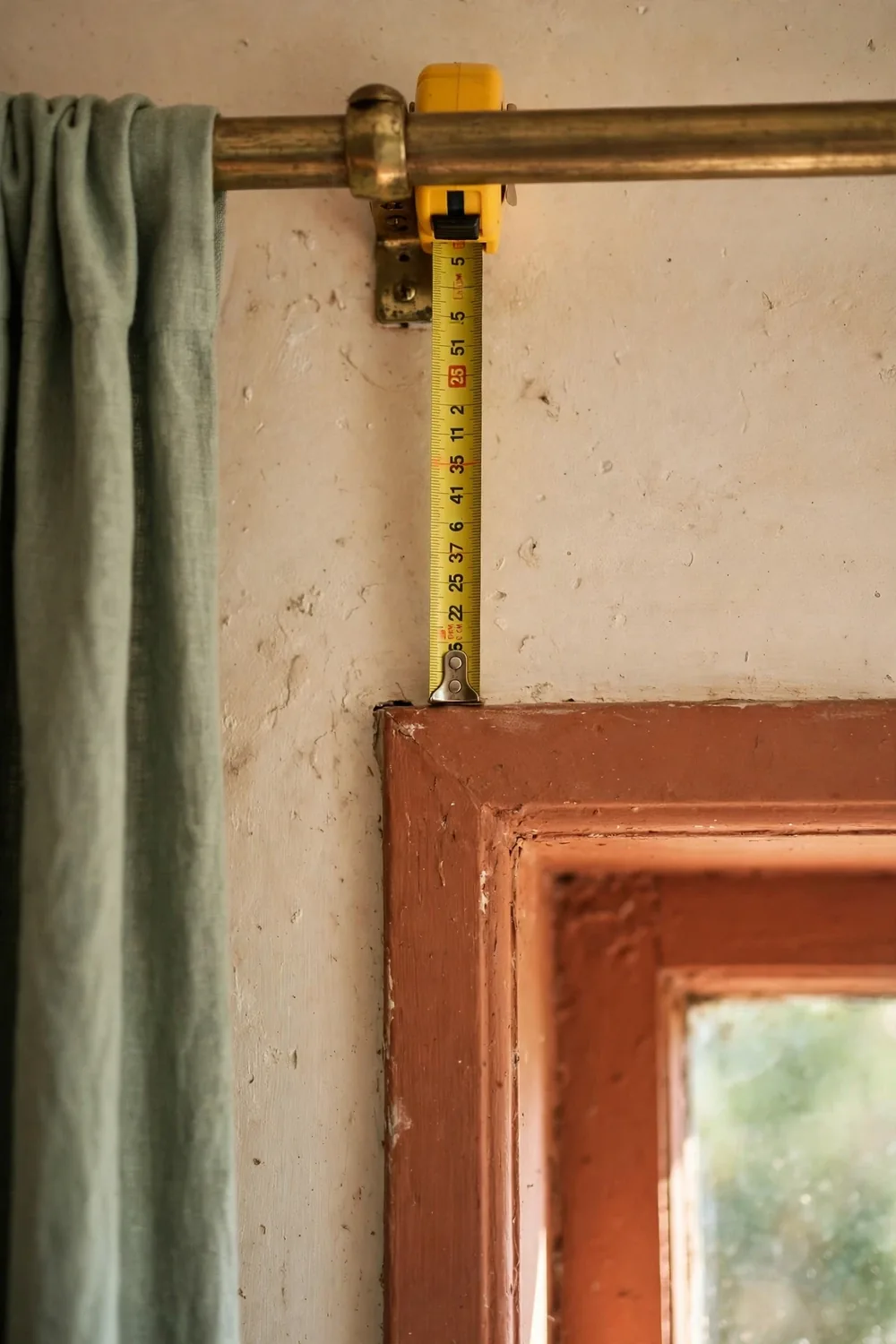
1. Hang the rod 4 to 6 inches above the frame
Start here, because this rule changes everything. Mount the rod 4 to 6 inches above the top of the window frame, not on the frame itself. Four inches is the minimum that reads as intentional. Six inches is the sweet spot on a standard 8 foot ceiling. On a 9 foot ceiling, go 8 to 10 inches above the frame.
Measure from the top of the trim, not from the glass. Trim adds about 2 to 3 inches around most windows. Mark both bracket positions, hold a level across the marks, and only then drill. A rod that sags even half an inch on one side is visible from across the room.
2. Let the hem just kiss the floor
Curtain length has three honest options, and only one suits most rooms. The hem should just kiss the floor, ending about 1 inch above it, so the panel brushes the floorboards without dragging.
The second option is a puddle, where 2 to 3 inches of fabric rest on the floor. A puddle looks romantic in a formal bedroom and terrible everywhere else, because it collects dust and pet hair. The third option is the floating hem, ending several inches above the floor, and it only works on a kitchen window above a sink or a window behind a radiator.
Measure the drop from the rod to the floor with a steel tape, and measure at both ends, because old floors slope. Buy panels 84 inches long for a standard 8 foot ceiling with a rod at 4 inches above the frame, and 96 inches long for a 9 foot ceiling.

3. Make the rod wider than the window
A rod that ends at the edge of the frame squeezes the curtains over the glass, and the window ends up half covered even when the curtains are open. Extend the rod 8 to 12 inches beyond the frame on each side, so the stacked panels sit on the wall, not on the glass. A 36 inch wide window needs a rod about 56 to 60 inches long.
This rule also fixes light. When panels stack on the wall, the full window stays clear during the day, and the room gets every inch of daylight it has. The same idea shapes a corner nook ideas plan, where pushing furniture to the edges leaves the middle of the room open and usable, and curtains work the same way.
Check the bracket placement before you buy. Brackets sit about 4 inches in from each end of the rod, so a rod that is too short leaves no wall for the stack.

4. Choose linen or a linen blend for everyday rooms
Fabric decides how a curtain hangs, and how it hangs decides how the room feels. Linen is my first choice for bedrooms and living rooms because it falls in soft vertical folds, lets a little light through, and looks better slightly wrinkled than perfectly pressed. A linen blend with 30 to 40 percent cotton or rayon holds its shape better than pure linen, and it still reads as natural fiber from across the room. Hold a swatch against the wall in daylight before you buy, because cream linen can read yellow under warm bulbs and gray under cool daylight.
Sheer linen is a different tool. It softens harsh daylight without blocking it, and it works on its own in a bedroom that faces a garden or a quiet street. In a bedroom that faces a busy road, sheer linen needs a lining or a second layer, which rule 5 covers. Avoid stiff polyester that holds a crease from the packaging and never relaxes, and avoid shiny satin in a calm bedroom, because the shine fights the rest of the room.

5. Layer a sheer panel behind a blackout panel
One layer rarely does two jobs well. A sheer linen panel gives you daylight and privacy during the day, and a blackout panel gives you darkness and sleep at night. Put both on the same rod with a double bracket, sheer closest to the glass and blackout closest to the room, and the window works around the clock.
A true blackout lining blocks about 99 percent of light when it is closed and the edges overlap the frame. A room darkening lining blocks about 80 to 90 percent and is enough for a living room or a guest room. For a bedroom, choose the full blackout lining and add a wraparound rod or return brackets, which bring the panel back to the wall and close the light gap at the sides. That side gap is where most morning light leaks in, not through the fabric itself.

6. Match the hardware to the room, not to the curtain
Hardware is small, but the eye finds it. A brass rod with simple ball finials suits warm wood, cream linen, and terracotta accents. A matte black rod suits sage green walls and dark wood. Pick one metal and repeat it in the room, on a lamp base or a picture frame, so the rod looks chosen rather than leftover.
Size the rod to the weight of the fabric. A 1 inch diameter rod carries linen panels up to about 60 inches wide without bowing. Heavier blackout lined panels need a 1 and 1 quarter inch rod, plus a center bracket on any span wider than 72 inches, or the rod will sag. Use about 1 ring per 4 inches of rod length, and clip rings hold linen better than sewn in tabs.

7. Steam the panels before you judge them
New curtains look terrible straight from the package, and that is normal. Fold creases are packaging problems, not curtain problems. Hang the panels, then steam them from top to bottom with a handheld steamer held about 2 inches from the fabric, and the folds will fall into soft vertical lines within about 10 minutes per panel.
Steam in the morning and judge the result in the evening. Linen relaxes slowly as it hangs. If you have no steamer, hang the panels in a steamy bathroom for 20 minutes with the door closed, then smooth the folds by hand. An iron works on a cotton blend, but use a pressing cloth, because direct heat can shine linen.

What went wrong the first time I hung curtains in our bedroom?
I hung the rod on the window frame itself, because the instructions on the box showed it that way and it looked easy. The rod sat 1 inch above the glass, the panels covered a third of the window even when they were open, and the room lost its best light. Worse, the panels ended 6 inches above the floor, because I had measured from the frame to the sill instead of from the rod to the floor, and the gap made the whole wall look unfinished.
I lived with it for three months before I fixed it. The fix took one afternoon: a new rod, mounted 5 inches above the frame and 10 inches wider on each side, panels 84 inches long that kissed the floor, and a handheld steamer for the creases.
Hang the rod 4 inches above the frame, let the hem kiss the floor, and the window stops being a hole in the wall and starts being the best part of the room.
FAQ
How high should I hang a curtain rod above the window? Hang it 4 to 6 inches above the top of the window frame on a standard 8 foot ceiling, or 8 to 10 inches on a 9 foot ceiling. Measure from the top of the trim and level the brackets.
How long should curtains be? Let the hem just kiss the floor, ending about 1 inch above it. Buy 84 inch panels for a standard 8 foot ceiling and 96 inch panels for a 9 foot ceiling, and measure the drop at both ends because old floors slope.
How wide should a curtain rod be? Extend the rod 8 to 12 inches beyond the frame on each side, so the open panels stack on the wall instead of covering the glass. A 36 inch window needs a rod about 56 to 60 inches long.
Do I need blackout curtains in a bedroom? A blackout lining helps in any bedroom that gets morning light or street light. Layer a sheer linen panel behind a blackout panel on a double rod.
Can I hang curtains without drilling? Yes, with tension rods inside the frame for sheers, or no drill brackets that grip the window trim for light linen panels. Heavy blackout panels need screws into a stud or toggle bolts.